

Background
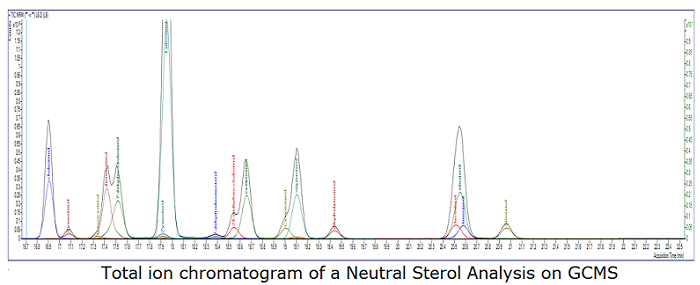
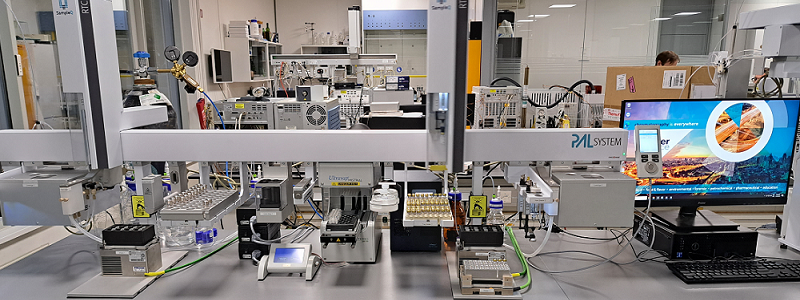
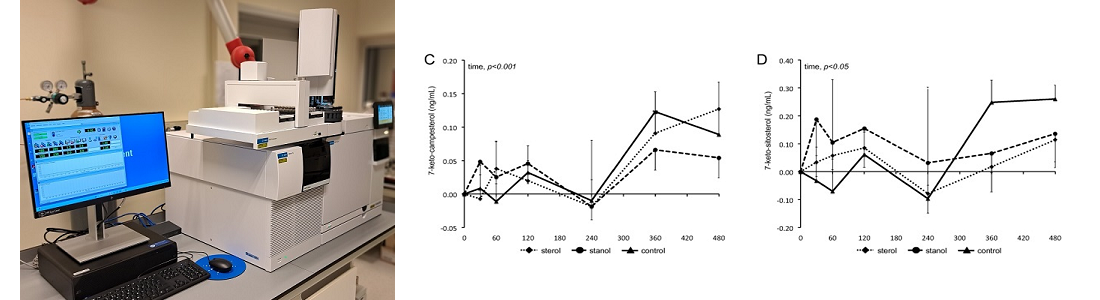
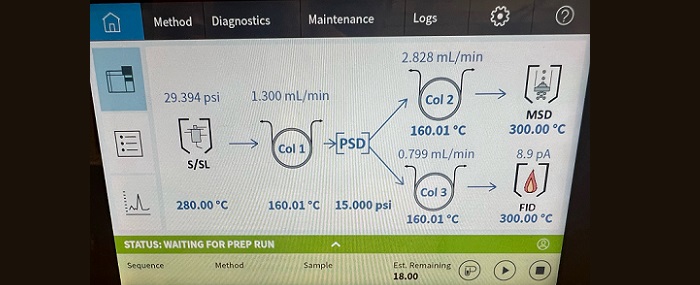
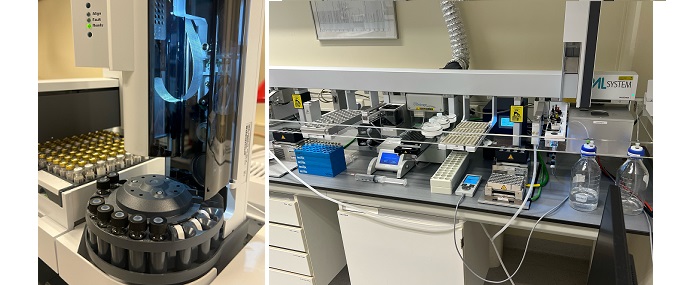
Cholesterol, non-cholesterol sterols (cholesterol precursors, plant sterols, plant stanols, oxysterols, oxyphytosterols) and fatty acids play crucial roles in a variety of (patho) physiological processes and as such in maintaining health or the development of disease. The STORM lab facilities offer a validated methodology to quantify these lipophilic compounds in serum, tissues or other (food) matrices.
Rationale
Here are different reasons to quantify these lipophilic compounds in serum, tissues or other (food) matrices.
Plant sterols and stanols are nowadays used as functional ingredients in LDL cholesterol lowering foods (margarines, drinks, yogurts, dressings etc) that are widely available in the supermarkets. More recently it became clear that plant sterols and stanols also have effects beyond lowering LDL cholesterol, i.e. lowering serum TAG concentrations and affecting immune cell behavior and immune fitness. Moreover, intermediates from the endogenous cholesterol synthesis cascade (cholesterol precursors) as well as oxysterols and oxyphytosterols have been shown to be involved in many (patho) physiological processes. Therefore, it is important to be able to have a method to quantify these non-cholesterol sterols in foods as well as in serum and tissues as causal or compliance markers.
Moreover, non-cholesterol sterols in plasma can also be used as markers to define a subject as being a cholesterol synthesizer or cholesterol absorber. It has been shown that these characteristics can be used to identify subjects with a higher disease risk. Absorber profiles are associated with a higher prevalence of CVD (mortality), coronary artery disease (CAD), chronic kidney disease (CKD) and all-cause mortality.
More important, patients with this absorber profile do not respond to usual statin treatment in terms of risk reduction. Instead, these patients respond better to interventions that inhibit cholesterol absorption. Therefore, markers reflecting these characteristics of cholesterol metabolism can be used to guide individualized / personalized cholesterol lowering (lifestyle) strategies to reach maximal benefit.
Foods contain a wide variety of fatty acids, which enter the circulation after intestinal absorption, and are incorporated in tissues, mostly as membrane constituents amongst others the phospholipids. Fatty acids possess a variety of biological activities such as regulation of membrane structure and function; regulation of intracellular signaling pathways, transcription factor activity, and gene expression. Moreover, poly unsaturated ω-3 and ω-6 FA are also essential precursors for lipid signaling molecules i.e. eicosanoids and endocannabinoids. Given these functions, FA are important mediators of health maintenance and disease risk. Considering their fundamental importance for human health, optimal fatty acid identification and reliable quantification assays are of major interest, as well as for the exploration of metabolic fluxes. Being able to quantify and compare concentrations of individual FA, preferably not only in human plasma phospholipids but also in different matrices will provide deeper insight in the role of fatty acid concentrations in various (patho)physiological processes. We are for example able to quantify 13C-labelled fatty acids and total fatty acids in plasma phospholipids in the same analytical assay by gas chromatographic triple quadrupole mass selective detector (GC-TQMS) to calculate tracer/tracee ratios.
Besides non-cholesterol sterols and fatty acids we also quantify beta-hydroxybutyrate or BHB. This is a compound that is synthesized by the body in conditions where there are not enough carbohydrates available to provide energy. However, it can also be used as a supplement since evidence is growing that it might have several beneficial effects in terms of health and disease. Therefore, a sensitive and valid method to quantify BHB is needed.
 .
.